From Stagnation to Structure: Fixing ENS Governance
One of the major criticisms of DAOs in general is that they don’t get things done, or if they do, they do so at tremendous cost and inefficiency. Eugene Leventhal
Abstract
This post is a follow-up on my previous post Toward Accountable and Strategic Funding in ENS which outlined my opinion that the ENS DAO's Service Provider Program in its current form is not a suitable mechanism for allocating significant resources.
Nothing I said in that post has meaningfully changed, which is why this follow-up is necessary.
In that post I stated that:
Many of the issues we’re facing now have plagued the ecosystem for a long time - lack of participation and a general absence of real accountability.
Six months on, the underlying structural issues remain unchanged.
In this piece, I expand on my view that the ENS DAO - as currently designed - lacks the structure to coordinate and execute a multi-year, multi-stakeholder roadmap. I propose a solution - the formation of an Operating Company (OpCo) made up of competent independent actors to co-ordinate and manage the day-to-day operations of the DAO, and the development of the ENS protocol.
I also examine the informal power dynamics that shape ENS governance today - the tight alignment of influential ecosystem actors with ENS Labs - and why this dynamic is ultimately incompatible with a resilient, decentralized governance system.
I write this noting the recent Snapshot votes based on the following temperature checks:
- [Temp Check] ENS Retro: An ENS DAO Retrospective
- [Temp Check] Replace the Working Groups with the ENS Admin Panel
and the broader question of what ENS governance needs to look like to remain functional, accountable and decentralised over the next decade.
The DAO
The reality is that the DAO should be directing development of the protocol. After all, it controls both the treasury and the governance of ENS.
The problem is that the DAO lacks the structure and talent to actually do this, and as a result ENS Labs ends up filling the void by default.
Decentralized governance simply doesn’t empower or incentivize the people with the skillsets required to lead and direct the development of a large protocol. The people capable of doing that work are in-demand and have options. They’re expected to operate inside a political process with no job security, no long-term continuity, and no real ownership.
It’s not surprising we’ve ended up here. The bureaucracy involved in making anything happen through a DAO means that nobody with the ability to take ownership of a major initiative is motivated to see it through from start to finish.
The uncomfortable reality is that decentralized governance, as currently structured, ends up empowering self interested people who are willing to play politics - not the people who are actually capable of directing a protocol of ENS’s scale.
That is to say, the system selects for the wrong people. The system selects for continuity, but not necessarily capability.
The Working Groups
For the majority of 2025 I attended all three Working Group calls each week. I ultimately stopped attending because I did not feel that it was the best use of my time.
I felt like Public Goods did do what it says on the tin - it funded some fantastic Public Goods. The calls were welcoming and friendly.
Metagov did a fantastic job handling the administrative tasks associated with the operation of the DAO. I did not however feel as though there was a lot of visible output from the Metagov calls - it felt like a lot was discussed, but not many novel governance initiatives were seen through end-to-end.
Ecosystem calls provided a platform for show-and-tell, hackathons have yielded some novel uses of ENS, and Limes did a fantastic job organizing events over the course of the year. That said, I don't think the ecosystem has noticeably grown.
My biggest concern with all three Working Groups was the fact that there were very few new attendees over the course of the year. There were even fewer new participants - people that meaningfully engaged in the discussions. These metrics are sadly not quantifiable as they were never measured.
My largest concern going forward, as I’ve stated before, is our diminishing talent pool - Nick Johnson
The original motivation for the creation of 'Working Groups' (as outlined in EP 0.4) stated that "A working group system will promote stability and encourage long-term thinking and planning". My personal opinion is that the Working Groups have not achieved this.
The Working Groups have been extremely political environments in which to work. My perception is that the way things are structured does not incentivize the stewards to do what is in the best interest of ENS - the structure unintentionally incentivizes role preservation over long-term strategic execution.
My personal opinion is that the Working Groups should be disbanded, and the good parts should be bought into a new structure (outlined below) in a manner that appropriately aligns incentives.
ENS Labs
ENS Labs are currently the core developers of the ENS protocol. They receive $9,700,000 USD of funding from the ENS DAO each year, and are mandated by the DAO to build ENSv2 - Namechain.
Before the DAO existed, the protocol was built by True Names Ltd, and many of the original founders and early contributors still work at Labs today.
My fundamental assumption is that many of these original contributors are pure technologists who, like me, like building best in class technology that solves real world problems.
One could argue that the formation of a DAO allowed founders and early contributors to realise value from what they built. I don’t think this is inherently bad - If I were in their position, I would probably have done the same.
Personally, I don’t doubt there were genuine intentions around decentralization at the start. But intentions only matter up to a point. In practice, Labs’ recent actions have not meaningfully pushed governance in a decentralized direction.
For example:
- Their work on Namechain continues to be very opaque.
- The ecosystem only recently learned of their intention to use Nethermind’s Surge stack.
- Based on publicly available information, there has been little discussion of how the new chain will be governed.
- Their approach to DNS and ICANN is opaque.
- External contributors have no clear visibility into the plan or strategy.
Opacity matters because the DAO cannot meaningfully exercise governance over work it cannot see, influence, or evaluate.
If there are legal reasons for Labs to keep things private, fine - but those things shouldn’t be private from the DAO. They should be confidential on behalf of the DAO. Right now Labs is the opaque layer. It should be the DAO.
It is worth highlighting that Katherine’s quarterly reports have been detailed, transparent, and genuinely insightful - I am appreciative of the effort that goes into producing them. My argument is not that Labs should disclose everything publicly, but that there needs to be better coordination between ENS Labs and the DAO where appropriate, so that resources are used efficiently and duplication of effort is minimized.
There is little value in the DAO attracting capable contributors if those contributors cannot be put to work due to information asymmetries.
Token Delegations
In my original post I stated:
Recent delegations have in my opinion in many respects bastardised the integrity of the program and the DAO.
I still believe that there would be huge value in large token holders who received significant allocations outlining statements of intent - if and how they intend to delegate their tokens. They are of course not obligated to do this, but I think it would provide real legitimacy to the ENS DAO if they were to do so.
Founder allocations exceed voting quorum, and exceed average voter turnout. Any significant delegation of these allocations risks concentrating influence in a manner that undermines decentralization.
The Retrospective
I am fully in favour of a retrospective review of DAO spending as proposed here. No competent or honest actor should be averse to having their output reviewed.
I was invited to participate in discussions pertaining to the proposal, noting that it was influenced by my original post. I shared this opinion. Should it pass, I am happy to provide any insight that I can to whoever is involved. I, of course, will not be involved in any capacity where there is obvious Conflict of Interest.
That said, I think that attention should be drawn to this post by Lucas Costa on Why your retrospectives don't work and how to fix them. The approach and execution of the retrospective should give appropriate consideration to the points outlined.
Ultimately I think that if we want real change we need to move towards a structure that:
- Empowers people to 'stop the line'.
- Assigns clear ownership.
- Ensures transparency, and accountability.
That structure, in my opinion, is an Operating Company (OpCo).
The retrospective is not mutually exclusive to the proposal outlined in this post, in fact it could provide useful insight that could influence how the OpCo operates.
The OpCo
If the DAO can’t attract or empower the people needed to advance ENS, then we need to create a structure that actually can.
Right now, ENS has two extremes:
- A highly capable technical team (Labs) that (understandably in my opinion) doesn’t want Governance as-is.
- A DAO that controls money but can’t execute.
What we need is to create capability at the DAO level.
What I am proposing is simple, an Operating Company led by three competent individuals with leadership, technical, and financial expertise.
I would like to fill the technical role, and if appointed I would step away from Unruggable to focus on it fully. The value of this proposed structure, however, does not depend on me.
These individuals would be given real authority by the DAO and empowered to hire, coordinate, and execute. They would operate with a constrained budget of $15–20M - essentially a consolidation of current outgoings (ENS Labs and SPP) with a reasonable operational overhead.
I would like to see the DAO move in a direction that makes collaboration easier than political infighting. To do that we need appropriate structure, clean definition of roles and responsibilities, and a good working culture.
At the moment ENS Labs do all of the protocol development because no other entity is empowered to participate in that arena. We need to create an environment in which our core protocol team don't perceive the DAO to be a hinderance to execution.
I believe that utilizing Nethermind's Surge for Namechain is an incredibly promising development. That said, I believe that the relationship with Nethermind should be established directly with the DAO. This can be facilitated with the outlined OpCo structure. The risk otherwise is a centralization of knowledge.
Similarly I believe that the OpCo should fund ENS' efforts in relation to ICANN and DNS independently - that team should be spun out of ENS Labs such that it can be appropriately resourced.
An OpCo is a lean coordination layer. I believe it will ultimately decrease costs and increase speed of execution.
Merriam Webster defines decentralization as "the dispersion or distribution of functions and powers". Decentralization does not require that everything be decided with a referendum.
The Service Provider Program
My original post outlined why I felt the Service Provider Program (SPP) was not fit for purpose. I still believe that. The SPP produced a lot of “performative participation” - applicants showing up, self-promoting for funding, then disappearing into the shadows created by a lack of real accountability.
In the OpCo structure I am proposing, the individuals who lead the OpCo would have the authority to hire an appropriate hierarchy underneath them. Existing Service Providers would be grandfathered into that structure at the appropriate level and held directly accountable by the people above them.
If they don’t deliver, the people above them should have the autonomy to end their streams immediately - subject to basic fairness and reasonableness. After all, accountability only works if it actually has teeth.
My view outlined in my initial post still stands, that:
"I believe a Technical Review Committee should be established. It should comprise of three independent individuals with a high degree of technical competency. They would be tasked with reviewing proposals and allocating funding."
I still believe this committee is essential - and it should sit above the current Service Providers in the hierarchy. At least two of the three committee members should come from outside the current ENS DAO ecosystem. If the DAO wants competence, it has to look beyond the people who have been empowered by default rather than by merit.
Optimistic Governance
In my original post, I suggested that delegates should retain a right of veto over decisions. I still think that has value. Delegates should not be involved in day-to-day operational decisions outside their expertise. They should however retain the ability to step in if the OpCo goes off the rails.
I think that there should be a high bar to removal - quorum, and 75% of delegates voting in favour of removal. The intention here is to empower long term thinking, and to appropriately align incentives.
Ultimately, I do not believe that the delegates should run ENS, but they should retain the ability to stop it from being run badly.
Tooling
I would like to see the OpCo contract with Anthony Leutenegger and his team at Aragon to build out appropriate tooling to facilitate execution of this vision.
I think delegation of responsibility is vital to a well functioning organization. Aragon have time and time again demonstrated subject-matter expertise, and the ability to execute.
Over the past year there have been discussions about private voting, token lockups, and permissioned access control - we have yet to see any of these. I am confident that Aragon could deliver these things, and more. Take a look at their blog for additional inspiration.
Accountability
One area where traditional corporate structures excel is accountability and consequences. For the most part people have managers (or equivalent) who show up, direct, ask questions, and expect follow-through. The current DAO structure does not have a parallel. Instead participants avoid sharing their opinions because of the political implications of doing so. Ultimately issues linger, nothing gets done, and mediocrity becomes normal.
An OpCo is the "consequence-producing" entity - the metaphorical adults in the room who ensure things actually get done.
There are plenty of competent people in the ENS ecosystem. There are also plenty who aren’t. DAOs love to sell themselves on “anyone can participate” which is admirable in theory but a terrible way to actually build a product. Competence still matters.
The OpCo structure eliminates the political implications of current accountability mechanisms. For example, members of the proposed Technical Review Committee are salaried individuals whose sole responsibility is technical co-ordination and accountability. If they choose to stop a contractual engagement with a Service Provider they need not be concerned about the security of their job.
Conflicts of Interest
In my original post, Nick made the following comment:
Unless a conflict is so pervasive that it would prevent a candidate from doing their job at all, conflicts should be dealt with by proactively declaring them, and recusal from votes that involve the conflict.
I completely agree.
There have on occasions been vague allusions to conflicts, but my personal perception is that not many conflicts of interest have been proactively declared over the past year. This is a problem.
I think that this pledge from Spence was the right approach, yet we didn't see any of the other Working Group stewards participate.
This is another area where I think that the proposed OpCo structure excels - the structure removes opportunity for conflict.
- You can't now be a steward and a Service Provider.
- You can't now get significant funds from the DAO and not be held accountable for how they are used.
Comparisons
In conversations with DAO participants many have stated that the ENS DAO is widely considered to be the 'best' DAO. I do not disagree with this sentiment, but I still believe that in it's current state it is not functioning optimally.
When the phrase OpCo is thrown around, one might instantly think of other DAOs (like Arbitrum - [1] [2] [3]) that have their own conceptualisation of an OpCo. I want to outline how this proposal differs. Additionally, I wanted to clarify how the needs of those DAOs differ materially from those of the ENS DAO.
The Rollups (Arbitrum and Optimism)
OP Labs (Optimism) and Offchain Labs (Arbitrum) have a soft monopoly on protocol development. This is because rollups are incredibly complex system, and the pre-requisite knowledge is incredibly specialized. They run their respective rollups - operating sequencers and batching/posting rollup state to Layer 1.
The ENS protocol is incredibly simple (in the grand scheme of things). If any given team disappears, nothing happens - ENS keeps working.
Both Optimism and Arbitrum have many many subcommittees. This has arguably caused fragmentation, unclear accountability, and execution bottlenecks. This proposal is lean - it empowers one entity to own both execution coordination and accountability. For ENS this is reasonable and justified because there are no complex moving parts.. yet.
Conclusion
At this point it’s obvious that the current structure isn’t working. The DAO can’t execute, Labs are operating opaquely, and the people being empowered aren’t the people we actually need.
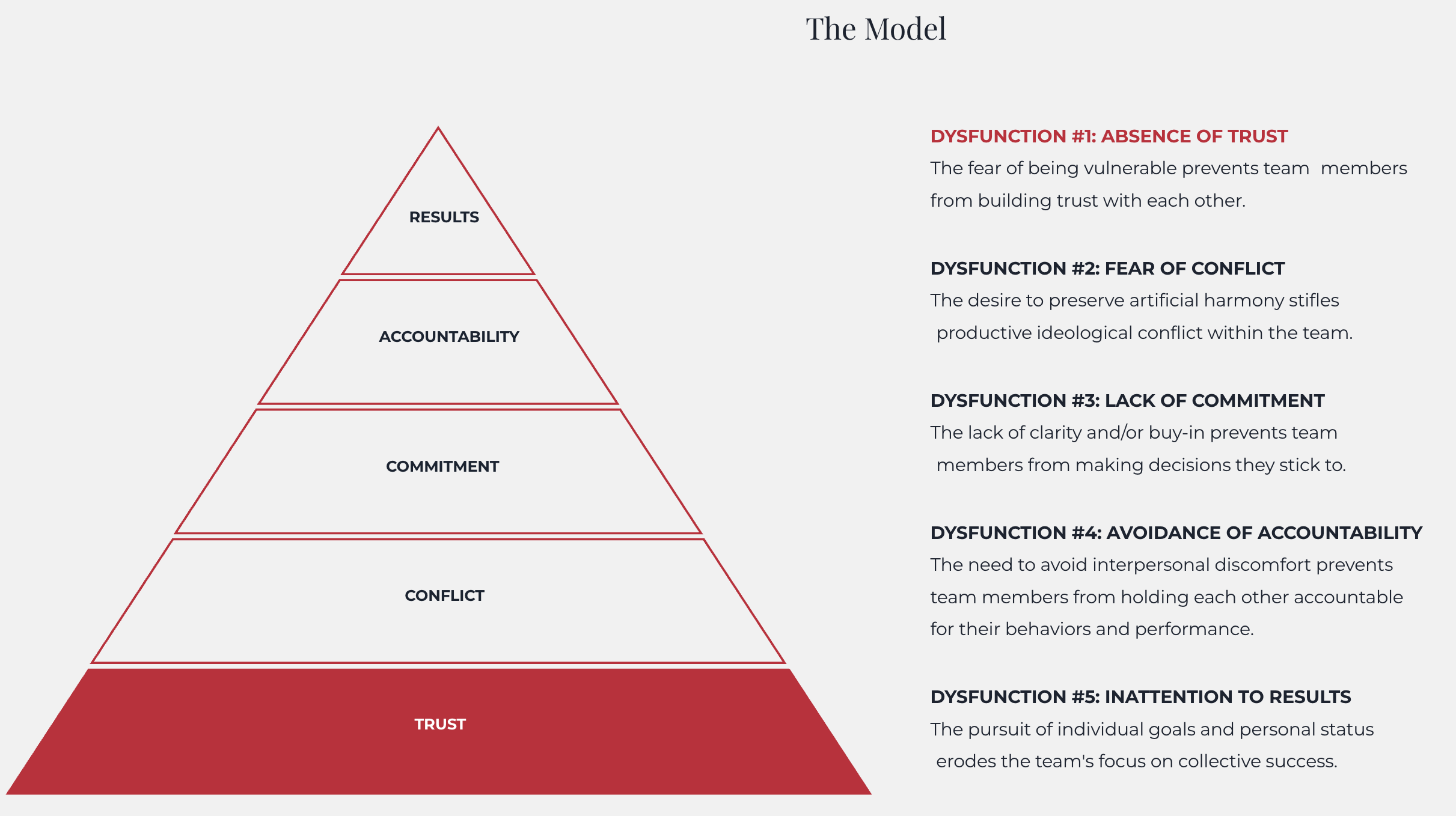
While researching this post, I came across a diagram from The Five Dysfunctions of a Team. The model is surprisingly relevant: the ENS DAO demonstrates an absence of trust, fear of conflict, lack of commitment, weak accountability, and an inconsistent focus on collective results.
These dysfunctions are structural, which means they are fixable. This proposal outlines a path to do exactly that - an OpCo.
There are, of course, significant intricacies to the execution of this vision, and there will be up-front costs. If there is broad support, I will formalize this into a Draft Proposal and Temp Check.
I am hopeful that over the coming four months we can engage in constructive dialogue around this proposal and iteratively move it forward in lockstep with the ENS Retro.